
Updated October 2026
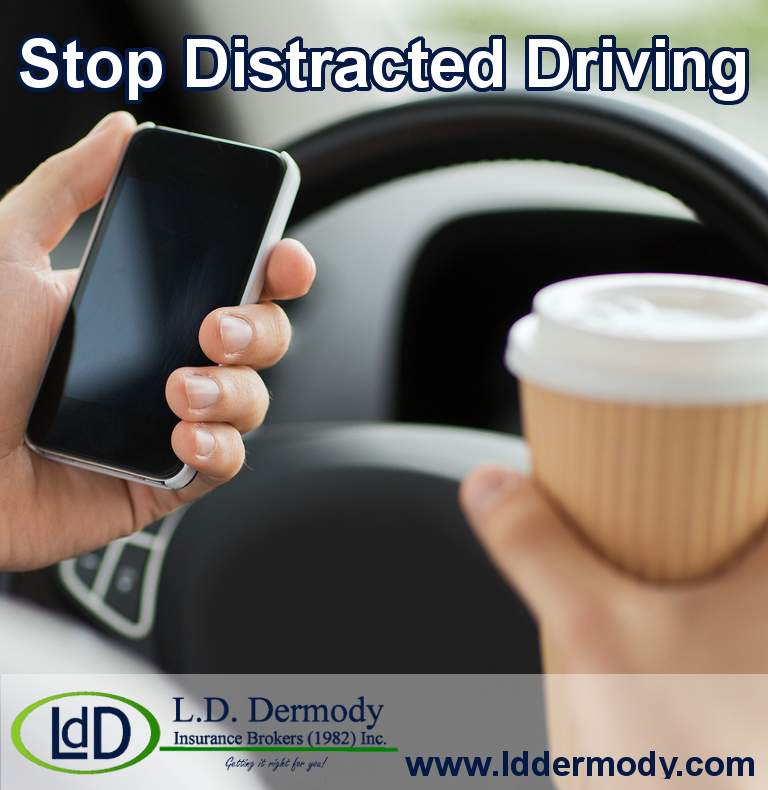
Distracted driving continues to be a serious road safety concern in Ontario.
Cellphones, navigation systems, electronic devices and other distractions can take a driver's attention away from the road, sometimes with devastating consequences.
Most drivers understand that texting while driving is dangerous. However, there are still misunderstandings about what Ontario's distracted driving laws prohibit, when hands-free devices are permitted and how a conviction can affect automobile insurance.
For example, did you know that Ontario's distracted driving laws apply even when you are stopped at a red light?
Or that a distracted driving conviction can result in a driver's licence suspension, even if no accident occurred?
At L.D. Dermody Insurance Brokers, we believe that understanding these rules can help drivers make safer decisions and avoid unnecessary insurance complications.
Here is what Ontario drivers should know.
1. What Is Distracted Driving?
Distracted driving occurs when something diverts a driver's attention away from the task of operating a vehicle safely.
Distractions can take several forms.
Visual distractions involve taking your eyes off the road, such as looking at a cellphone.
Manual distractions involve taking your hands away from driving controls, such as reaching for an object.
Cognitive distractions involve thinking about something other than driving, even if your eyes remain on the road.
Some activities involve more than one type of distraction.
For example, reading a text message can take your eyes off the road, while composing a reply may also require you to handle a device and concentrate on the message.
Even a brief distraction can reduce the time available to react to changing traffic conditions.
2. What Does Ontario's Distracted Driving Law Prohibit?
Ontario's distracted driving laws specifically address handheld communication devices, electronic entertainment devices and certain display screens.
While driving, you generally cannot:
-
Hold or use a cellphone to text, email or dial.
-
Hold or use a handheld electronic entertainment device.
-
Watch a display screen unrelated to driving.
-
Manually program a GPS on a cellphone or handheld communication device.
Simply holding a prohibited handheld device while driving can result in a charge.
There are limited exceptions, including using a device to contact emergency services.
The rules also permit certain hands-free uses, subject to restrictions.
The safest approach is to set up your phone, navigation system and other devices before you begin driving.
For current legal requirements, see the Ontario government's Distracted Driving information.
3. Can You Use Your Cellphone at a Red Light?
No.
A common misconception is that drivers can check their phones while stopped at a red light or waiting in traffic.
Ontario's handheld device restrictions continue to apply in these situations.
For example, a driver stopped at an intersection should not pick up a cellphone to read a text message.
The fact that the vehicle is temporarily stationary does not make handheld phone use permissible.
If you need to use your phone, pull over and park safely in a location where doing so is permitted.
4. Are Hands-Free Devices Legal in Ontario?
Ontario permits certain hands-free communication devices, including systems using Bluetooth, an earpiece or other approved hands-free arrangements.
However, there are restrictions on how these devices may be operated.
For example, drivers may generally use permitted hands-free functions and limited controls, but should not handle or manipulate a cellphone as though it were a handheld device.
A securely mounted cellphone may be used for certain permitted functions, such as making, answering or ending a call through the allowed controls.
Drivers should avoid navigating menus, typing messages or otherwise interacting with devices while driving.
It is also important to understand that hands-free does not necessarily mean distraction-free.
A conversation can still divert attention from driving.
If a hands-free conversation contributes to unsafe driving, other charges, such as careless driving, may be possible depending on the circumstances.
5. Can You Use GPS While Driving?
GPS navigation systems are common in modern vehicles.
Ontario generally permits drivers to view navigation information on a screen built into the vehicle or on a securely mounted device.
However, there are restrictions on programming and operating navigation systems while driving.
Before leaving, enter your destination and review your route.
If you need to change your destination, use an appropriate permitted voice-command function or stop and park safely before making manual adjustments.
Avoid holding a cellphone to check directions.
A navigation system should help you drive safely, not become another distraction.
6. What Are the Penalties for Distracted Driving in Ontario?
Ontario imposes significant penalties for distracted driving convictions.
For drivers holding a full licence, the consequences generally increase with subsequent convictions within the applicable five-year period.
| Conviction | Fine range | Demerit points | Licence suspension |
|---|---|---|---|
| First | $500–$1,000 | 3 | 3 days |
| Second | $500–$2,000 | 6 | 7 days |
| Third or subsequent | $500–$3,000 | 6 | 30 days |
These are statutory fine ranges. Court-imposed fines, victim fine surcharges and other applicable costs can affect the amount payable.
A licence reinstatement fee may also apply.
The financial consequences can extend well beyond the traffic ticket itself.
7. Are the Penalties Different for G1 and G2 Drivers?
Yes.
Ontario's graduated licensing system imposes particularly serious consequences on novice drivers.
For drivers holding G1, G2, M1 or M2 licences, distracted driving convictions generally carry the same fine ranges as for fully licensed drivers.
However, rather than receiving demerit points for the distracted driving conviction, novice drivers face escalating licence suspensions.
These generally include:
-
First conviction: 30-day licence suspension.
-
Second conviction: 90-day licence suspension.
-
Third conviction: Licence cancellation and removal from the graduated licensing system.
A driver whose novice licence is cancelled may have to restart the licensing process.
For young drivers, the consequences can be particularly disruptive.
A licence suspension may affect transportation to school, employment and other commitments.
Parents should discuss distracted driving rules with newly licensed drivers before they begin driving independently.
8. How Does a Distracted Driving Conviction Affect Automobile Insurance?
A distracted driving conviction can affect your automobile insurance premiums and eligibility.
Insurance companies consider a driver's conviction history when assessing risk.
However, not all convictions are treated the same way.
Insurers may classify traffic convictions as minor, major or serious, depending on their underwriting and rating rules.
Distracted driving convictions may be treated as major convictions by some insurers.
The consequences can include:
-
Loss of a conviction-free discount.
-
Increased automobile insurance premiums.
-
Reduced eligibility for preferred insurance programs.
-
Changes in the insurer's willingness to renew coverage.
-
Difficulty obtaining competitive quotations from other insurers.
The actual effect depends on the insurance company, the driver's record and the applicable underwriting rules.
There is no universal percentage increase that applies to every Ontario driver convicted of distracted driving.
A driver with an otherwise clean record may be affected differently from someone who already has multiple convictions or at-fault accidents.
9. Do Demerit Points Determine Your Insurance Premium?
Not directly.
This is another common misunderstanding.
Ontario's demerit point system is administered by the Ministry of Transportation and is intended to address driver behaviour and licensing consequences.
Automobile insurers generally evaluate the underlying traffic convictions rather than simply using the total number of demerit points.
For example, a conviction carrying three demerit points is not necessarily treated the same way as every other three-point offence.
The nature of the conviction matters.
Similarly, a driver who has accumulated no demerit points may still have convictions that affect insurance.
The distinction is important because paying a fine or having demerit points eventually removed does not necessarily eliminate the conviction's insurance consequences.
10. How Long Can a Distracted Driving Conviction Affect Insurance?
Insurance companies generally consider driving convictions over a defined experience period.
For many Ontario automobile insurers, convictions within the preceding three years are particularly relevant to rating.
However, underwriting rules vary, and certain serious driving offences or licensing circumstances may be considered differently.
The applicable period may also depend on the insurer's rating and eligibility rules.
A conviction may continue to affect premiums at subsequent renewals while it remains within the insurer's relevant experience period.
It is important not to confuse the insurer's conviction-rating period with the separate period Ontario uses when determining escalating distracted driving penalties.
These are different systems.
11. Can a Distracted Driving Conviction Lead to Non-Renewal?
Potentially.
Insurance companies establish underwriting rules governing which drivers and risks they are willing to insure.
A distracted driving conviction may affect eligibility, particularly when combined with other convictions, licence suspensions or at-fault accidents.
Depending on the insurer's approved rules and the driver's circumstances, the company may impose a higher premium or determine that the risk no longer qualifies for a particular program.
This does not mean every distracted driving conviction automatically results in non-renewal.
However, it can make obtaining affordable insurance more difficult.
If your driving record changes, your insurance broker can help explain how the available insurers may assess it.
12. What Happens if You Cause an Accident While Distracted?
Distracted driving can have serious consequences when it contributes to a collision.
A driver may face traffic charges, an insurance claim and potential civil liability arising from the same incident.
However, these matters are assessed under different rules.
Traffic Charges
Police may investigate whether a driver violated Ontario's distracted driving laws or committed another driving offence.
Insurance Fault Determination
Ontario automobile insurers assess fault for collisions using the province's Fault Determination Rules.
An insurance fault assessment is not automatically determined by whether police issued a traffic ticket.
For example, a driver may be found at fault for an accident even if no charge was laid.
Conversely, the existence of a traffic conviction does not replace the insurer's obligation to assess the collision under the applicable rules.
Insurance Premiums
A driver involved in an at-fault collision may face premium consequences arising from the accident.
If the driver also receives a distracted driving conviction, the conviction may create additional rating or eligibility consequences.
The insurer's treatment depends on the circumstances, policy and underwriting rules.
13. Does Automobile Insurance Still Cover an Accident Involving Distracted Driving?
A distracted driving charge or conviction does not automatically mean that all automobile insurance coverage is void.
Ontario automobile insurance is governed by policy terms and legislation.
An insurer must consider the particular circumstances of the loss and the coverage involved.
For example, an at-fault accident involving a driver who was distracted may still result in covered claims, subject to the policy's terms and applicable law.
However, drivers should never assume that every loss or expense will be covered regardless of the circumstances.
There may be separate issues involving other policy violations, exclusions or statutory conditions.
If an accident occurs, report it promptly and provide accurate information to the insurer.
14. Can You Be Charged for Distractions Other Than Cellphone Use?
Yes.
Ontario's specific handheld device law does not prohibit every activity that could distract a driver.
For example, eating, drinking, adjusting clothing, grooming or reaching for objects are not automatically offences under the handheld device provisions.
However, these activities can still interfere with safe driving.
If a driver's conduct endangers other road users, police may consider charges such as careless driving.
In serious circumstances, dangerous driving charges may also be possible.
This means an activity does not have to involve a cellphone to create legal consequences.
The driver's responsibility is to remain attentive and operate the vehicle safely.
15. Why Are Young Drivers Particularly Vulnerable?
New drivers are still developing important skills, including hazard recognition, judgment and the ability to respond quickly to changing traffic conditions.
Adding distractions can make these tasks more difficult.
Young drivers may also feel pressure to respond immediately to messages or notifications.
Parents can help by establishing clear expectations about cellphone use while driving.
For example:
-
Put the phone away before starting the vehicle.
-
Activate driving mode.
-
Do not read or respond to messages while driving.
-
Set navigation instructions before leaving.
-
Pull over safely if communication is necessary.
-
Avoid distracting conversations with passengers.
Parents should also model safe behaviour when driving.
For more information about young drivers and insurance, see our article Why Is Insurance So Expensive for Young Drivers?
16. Practical Ways to Avoid Distracted Driving
Many distractions can be reduced through simple habits.
Before You Drive
Set your destination. Enter GPS information before leaving.
Choose your music. Set up playlists, podcasts or radio stations in advance.
Put your phone away. Place it somewhere that will not tempt you to check it.
Activate driving mode. Many phones can silence notifications or send automatic replies.
Secure loose objects. Make sure items cannot roll or fall into areas where they might interfere with driving.
While Driving
Keep your attention on the road. Watch traffic, pedestrians, cyclists and changing road conditions.
Avoid unnecessary device interactions. Even permitted hands-free activities can be distracting.
Ask passengers for help. A passenger can assist with directions or communications.
Do not reach for dropped items. Wait until you can stop safely.
Avoid emotionally distracting conversations. If a conversation requires significant attention, continue it after parking.
If You Need to Use Your Phone
Find a safe and lawful place to pull over and park before handling the device.
Do not assume that stopping temporarily at a red light or in traffic is sufficient.
17. What Should You Do if You Receive a Distracted Driving Ticket?
If you receive a ticket, read it carefully and understand the available options and deadlines.
You may wish to obtain legal advice about the charge and potential consequences.
Do not assume that the fine is the only financial consideration.
A conviction can also affect your driver's licence and automobile insurance.
If a conviction or licence suspension occurs, discuss the insurance implications with your broker.
Your broker cannot change the legal outcome of a traffic charge, but can help explain how insurance companies may assess your driving record.
Safe Driving Can Help Protect Your Insurance Record
Distracted driving is preventable.
A message, phone call or notification is rarely worth the risk of causing an accident or injuring someone.
In Ontario, distracted driving can also lead to significant fines, demerit points, licence suspensions and increased insurance costs.
The consequences may continue long after the traffic ticket has been paid.
The best approach is simple: keep your attention on driving and deal with your phone or other distractions only when you are safely parked.
At L.D. Dermody Insurance Brokers, we help Ontario drivers understand how their driving records can affect automobile insurance premiums and eligibility.
If you have questions about your automobile insurance or how a conviction may affect your coverage, contact our office.
L.D. Dermody Insurance Brokers is here to help you understand your automobile insurance options and make informed decisions about your coverage.
This article provides general information for Ontario drivers as of October 2026. Traffic laws, penalties and insurance rules may change. Insurance premiums, eligibility, rating classifications and coverage vary by insurer and policy. For legal advice concerning a traffic charge, consult a qualified legal professional.