
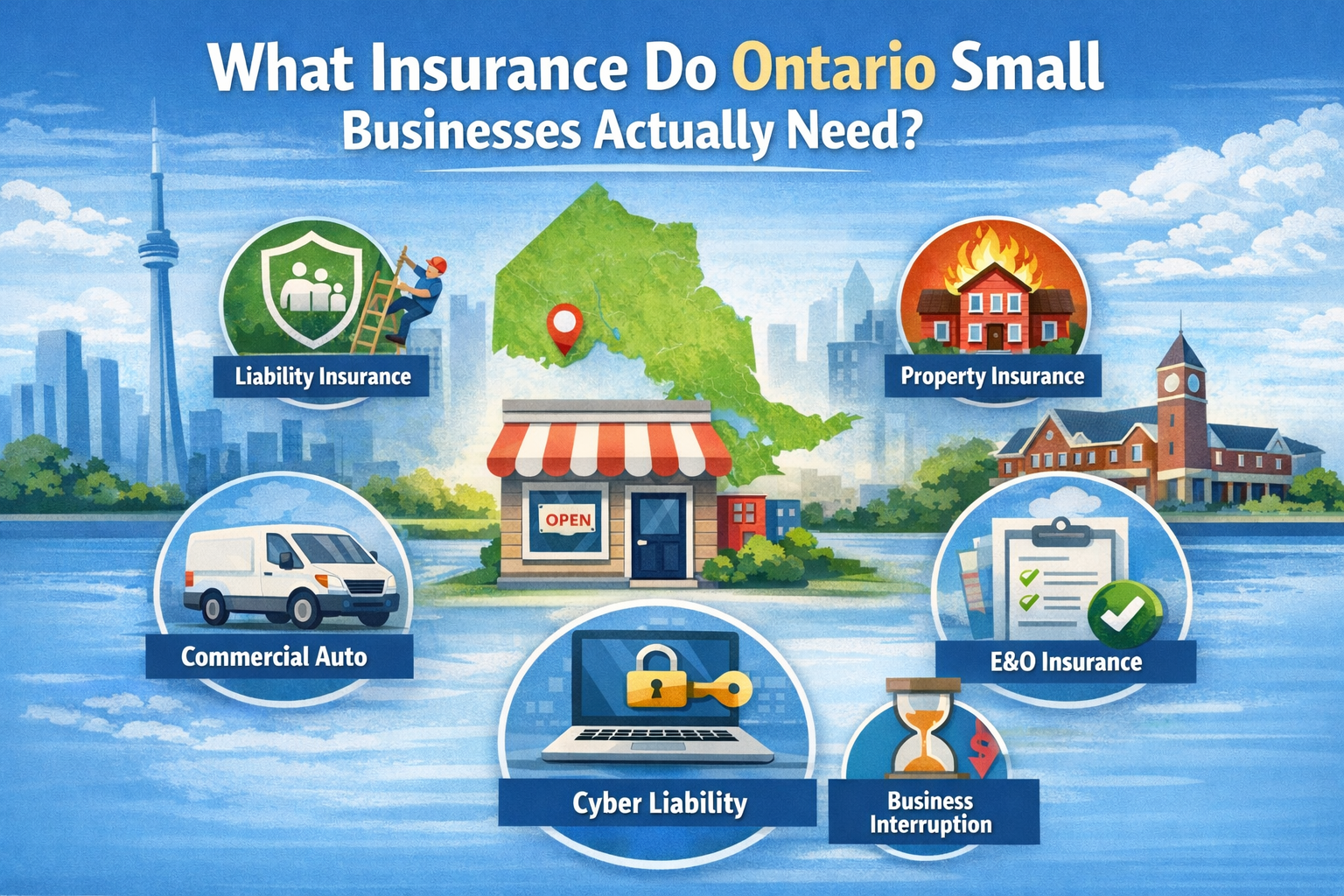
What Insurance Do Ontario Small Businesses Actually Need?
If you run a small business in Ontario, insurance can feel confusing, and often more complicated than it needs to be. Many business owners ask the same question:
“What insurance do I actually need, and what’s optional?”
The answer depends on your industry, location, and how you operate. But most Ontario small businesses share common risks. Below is a practical guide to the most important types of business insurance in Ontario, with real-world local examples.
Commercial General Liability Insurance (Essential for Most Ontario Businesses)
Commercial General Liability (CGL) insurance is the foundation of most business insurance policies in Ontario. While not always legally required, it’s often required by landlords, clients, municipalities, and contractors.
It protects your business if:
• A customer slips and falls at your location
• You damage a client’s property while working
• You’re accused of negligence, libel, or slander
Ontario example:
A retail shop in Whitby has a customer slip on a wet floor during winter. A liability policy can help cover legal costs and settlement expenses.
A contractor working in Toronto or Oshawa may not be allowed on a job site without proof of $2 million in liability coverage.
Best for:
Retailers, contractors, consultants, trades, wholesaler, manfacturers and home-based businesses.
Commercial Property Insurance (If You Own Equipment or Lease Space)
Commercial property insurance covers your physical assets, including:
• Contents and equipment
• Inventory and tools
• Fire, theft, and vandalism
• Loss of income after an insured claim
Even if you operate from home, standard home insurance in Ontario usually excludes business property and business activities.
Ontario example:
A professional office in Ajax suffers smoke damage from a neighbouring unit. Property insurance can help cover repairs, damaged equipment, and business interruption costs.
A trades business storing tools in a garage in Clarington may not be covered under a personal home policy.
Best for:
Offices, retail stores, trades, manufacturers, and home-based businesses with equipment.
Commercial Auto Insurance (Legally Required in Ontario)
If your business owns or regularly uses vehicles, commercial auto insurance may be legally required under Ontario law.
This applies to:
• Vehicles registered to a business
• Company-owned or leased vehicles
• Certain regular business use of personal vehicles
Personal auto policies often exclude commercial use, especially for deliveries, job site visits, or transporting tools.
Ontario example:
A landscaping company operating across Durham Region uses branded pickup trucks. These vehicles require commercial auto insurance.
A sales consultant using a personal car to visit clients throughout the GTA may need business use declared or a commercial policy.
Professional Liability (Errors & Omissions) Insurance
Professional Liability insurance (also known as Errors & Omissions or E&O) protects businesses that provide advice, services, or professional expertise.
It helps if a client claims:
• Your advice caused them financial loss
• Your work was incomplete or inaccurate
• A mistake or omission impacted their business
Ontario example:
An IT consultant in Pickering provides system advice that leads to downtime for a client. E&O insurance can help respond to legal claims.
A marketing consultant working with Ontario-based clients may be contractually required to carry E&O coverage.
Best for:
Consultants, IT professionals, designers, accountants, and service providers.
Cyber Insurance (Increasingly Important for Ontario Small Businesses)
Cyber insurance is no longer just for large corporations. Small businesses across Ontario are frequent targets because they often rely on email, cloud systems, and digital records.
Cyber insurance may help with:
• Ransomware attacks
• Data breaches involving client information
• Notification and credit monitoring costs
• Legal and recovery expenses
Ontario example:
A small professional firm in Bowmanville experiences a phishing attack that exposes client data. Cyber insurance can help cover response costs and legal obligations under privacy laws.
Best for:
Any business handling personal, financial, or confidential data.
Business Interruption Insurance
Business interruption insurance helps replace lost income if your business is temporarily forced to close due to an insured loss, such as a fire or major water damage.
It can help cover:
• Lost revenue
• Ongoing expenses
• Temporary relocation costs
Often included as part of a commercial property policy.
Ontario example:
A restaurant in Oshawa closes for several weeks due to fire damage. Business interruption coverage can help keep cash flow going while repairs are completed.
What Insurance Is Actually Mandatory in Ontario?
For most Ontario small businesses:
• Commercial auto insurance is mandatory when applicable
• WSIB coverage may be required depending on your industry and staffing
Other coverages are not legally required but may be contractually required or strongly recommended based on risk.
The Bottom Line: Ontario Business Insurance Isn’t One-Size-Fits-All
The right insurance coverage depends on:
• Your industry
• Your location in Ontario
• Whether you have employees or vehicles
• Your contracts and clients
• Your tolerance for risk
Working with a local Ontario insurance broker helps ensure you’re protected without paying for coverage you don’t need, and without discovering gaps when it’s too late.
Need Help Reviewing Your Ontario Business Insurance?
If you’re unsure whether your current coverage fits your business, a review with a local Ontario insurance broker can help you make informed decisions before renewal or growth.